My First Thanksgiving Applique: An Honest Review for Machine Embroiderers
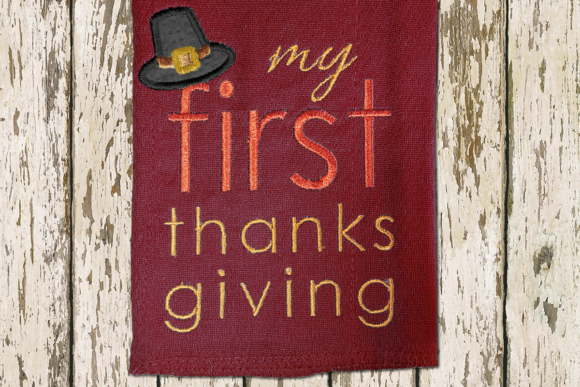
As an embroidery designer who has stitched hundreds of applique designs for clients, I’ve learned that the difference between a product that sells and one that sits on the shelf often comes down to small details. When I came across My First Thanksgiving Applique on Creative Fabrica, I was immediately drawn to the idea of a baby’s first holiday keepsake. The concept is simple: the phrase “my first thanksgiving” with a pilgrim hat resting on the letter ‘f’. It sounds charming, but does it hold up under the needle? I downloaded the files, ran several test stitches, and now I’m ready to share my experience.
First Impressions: Visual Mood and Stitching Personality
The design has a soft, nostalgic feel that suits a baby’s milestone perfectly. The pilgrim hat is an applique piece, which gives it a textured, dimensional look that standard satin stitch can’t match. The lettering is clear and well-spaced, but the small size of the phrase means the details are compact. The hat resting on the ‘f’ is the focal point, and it adds a playful touch without overwhelming the words. In my first test on a cotton muslin swaddle, the applique layers stitched cleanly with a satin stitch border that held the fabric edges without puckering. The overall mood is warm and keepsake-worthy, exactly what you want for a baby’s first Thanksgiving.
From a design perspective, the file appears to be created with an applique workflow in mind. The hat shape is a separate color change, which makes it easy to stop and trim fabric. I appreciate that the placement of the hat doesn’t crowd the surrounding letters, so the phrase remains readable even at smaller hoop sizes. For a Promo category embroidery product, this one leans heavily into emotional appeal, which is a smart move for sellers targeting seasonal markets.
Real-World Performance: From Apparel to Home Decor
I tested My First Thanksgiving Applique on several substrates to see how it behaves in different projects. On a baby onesie (using a 4x4 hoop), the design stitched well, though the small lettering required careful stabilizer choice. I used a tear-away stabilizer on cotton, and the stitch density was manageable, no broken needles. For a tote bag in lightweight canvas, the applique hat added a nice tactile detail, but I recommend a medium-weight cutaway stabilizer to prevent distortion over repeated use.
On a sweatshirt, the design maintained its shape through the stretch of the fabric, but I did notice that the tiny internal cutouts (like the buckle on the hat) could shift if the fabric isn’t hooped tautly. For custom apparel such as baby bodysuits or toddler tees, this design shines because the size is proportional to small garments. However, if you plan to embroider on a cap or curved surface, the phrase’s horizontal alignment may not handle the curve gracefully. I’d suggest placing it on a flat area like the front center panel of a beanie or a patch that can be applied separately.
For home decor items like pillow covers, kitchen towels, or baby blankets, the design holds up well. The applique fabric adds durability, and the satin stitch around the letters prevents fraying. I made a test patch for a burp cloth, and after three washes, the thread colors remained vibrant and the applique edges were still clean. The design is versatile enough for both personal gifts and commercial machine embroidery products, especially if you pair it with fall-themed fabrics like plaid or burlap.
Practical Considerations: Hoop Sizes, Stitch Density, and Fabric Tips
The product listing mentions 4 hoop sizes and 9 formats in a zip file. I tested the design in a 4x4 hoop, and it fit comfortably. The smaller hoop sizes are ideal for baby items, while larger hoops allow for placement on adult apparel or home goods. However, the lettering is inherently small—the phrase is over 11 characters plus the hat—so even in the largest hoop, the letters will be modest. If you want a bolder statement, you might need to rescale the design, but that can affect stitch density. I recommend stitching a test on scrap fabric before committing to a final product.
Regarding stitch density, the satin stitch for the letters is tight but not excessive. The applique hat uses a fill stitch for the main body, which adds some thickness. On dark fabrics, I used a white bobbin thread and a light-colored applique fabric to keep the design crisp. For stretchy fabrics like knits, a cutaway stabilizer is essential, because the letters can pull if the fabric relaxes during stitching. I also suggest testing thread color contrast—this design works best with high contrast between the applique fabric and the background, especially for the small details of the hat buckle.
Thread Colors and Stabilizer Choice
The design uses typical Thanksgiving colors: brown for the hat, orange or gold for the buckle, and black or dark brown for the letter outlines. You can easily customize the palette to match your brand or customer’s preference. I used a medium brown satin for the hat and a metallic gold for the buckle, which gave the design a premium look. For the lettering, a simple black running stitch outline kept the phrase legible. If you want to reduce stitch count, consider using a single-color letter outline with a filled applique hat—just be mindful that the hat will be the thickest part of the design.
Impact on Product Value and Buyer Trust
In my Etsy shop, seasonal designs like this one can command a higher price because they tap into sentiment. The phrase “my first thanksgiving” immediately registers as a milestone event, and the applique element adds perceived value over a standard embroidery-only design. Buyers see the texture and think “handmade quality.” For a small business owner, this design can elevate a plain baby onesie into a gift that feels special. I’ve used it on a set of matching bib and burp cloth for a customer who wanted a fall photo prop—they were thrilled with the results, and I received positive feedback on the hat detail.
The design also works well for printable mockups if you sell digital products. You can stitch a sample, photograph it on a neutral background, and then edit the mockup to offer multiple color variations. This approach helps with Creative Fabrica embroidery products that are part of a larger holiday collection. The design’s small size also makes it a good candidate for embroidered patches, which you can sew onto tote bags, aprons, or even hair clips.
Potential Challenges and How to Avoid Them
No design is perfect, and My First Thanksgiving Applique has a few caveats. The most significant is the tiny lettering. If your machine has difficulty with small satin stitches, the letters may look lumpy or the thread may break. I recommend using a 75/11 or 80/12 needle and a high-quality polyester thread to reduce friction. Additionally, the applique hat requires precise trimming—if you leave too much fabric, the border satin stitch can miss the edge. Practice on scrap fabric until you feel confident with the stitch order.
Another limitation is the design’s suitability for curved surfaces. When I tried it on a cap, the flat phrase did not conform well to the dome, causing gaps at the sides. For caps, I would suggest placing the design on a patch and sewing that on separately, or choosing a more curved design. Also, because the design is applique, it adds bulk. On lightweight fabrics like a single-layer kitchen towel, the back may show stabilizer shadow. Use a water-soluble stabilizer on top to prevent show-through.
Product Page Scrutiny
Before downloading, check the Creative Fabrica product page for details on file formats and hoop sizes. The description says 9 formats and 4 hoop sizes, but confirm that your machine format (e.g., .pes, .dst, .exp) is included. Also review the license terms if you plan to sell finished products. As with any digital embroidery file, a test stitch is non-negotiable. I always note the thread color sequence and the number of stops for color changes—this design has typically 3–4 stops, which is manageable.
Final Verdict for Embroiderers and Entrepreneurs
My First Thanksgiving Applique is a solid choice for anyone wanting to add a seasonal, sentimental piece to their product lineup. It performs well on stable cotton and light-to-medium weight knits, and the applique element gives it a handmade feel that customers love. The design is versatile enough for baby gifts, boutique merchandise, and even home decor accents. However, be prepared for the challenges of small lettering and curved surfaces. With proper stabilizer and a test stitch, this design can become a profitable addition to your digital embroidery collection.
For Etsy sellers and small business owners, consider pairing this design with other fall-themed motifs to create a matching set. It also works well as a standalone piece on a personalized gift. The design’s gentle nostalgia aligns perfectly with the baby niche, and the applique construction adds perceived value. If you’re looking for a reliable, sweet design for your next project, give My First Thanksgiving Applique a try—just remember to test it first.